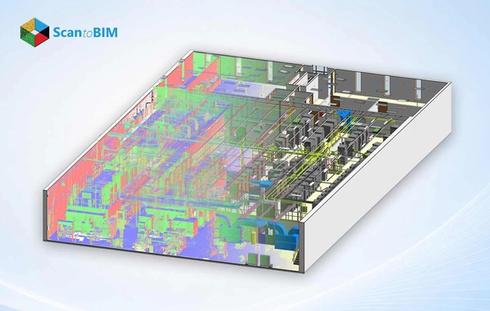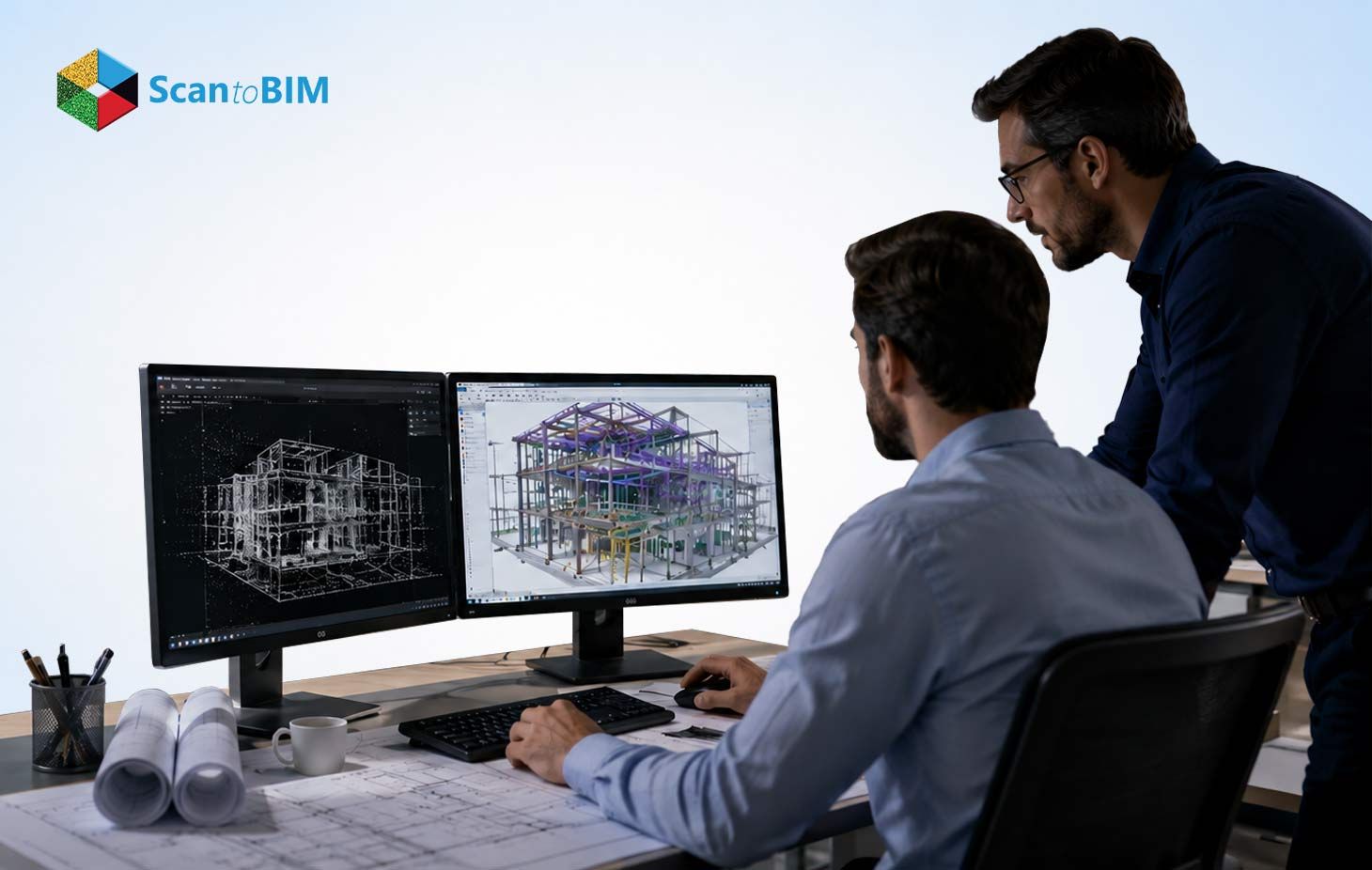
A scanner reads a building in one afternoon. Turning that scan into a usable model takes much longer, and that gap is where most firms feel the strain. Laser scanning captures a site as a point cloud, which holds millions of measured points. The data is useful. Turning it into a smart model needs skilled people, good software, and real-time. Many firms find that this work consumes the hours their designers should be spending on design.
Outsourcing gives you a way out of that strain. This blog shares an honest picture of both the good and hard parts of giving the work to an outside partner. You will see how the work flows, where it saves money, and where you need to stay careful. The points here speak to project leads, BIM managers, and owners making the choice. The goal is simple. Help you decide clearly and act with a plan.
What Are Scan to BIM Services?
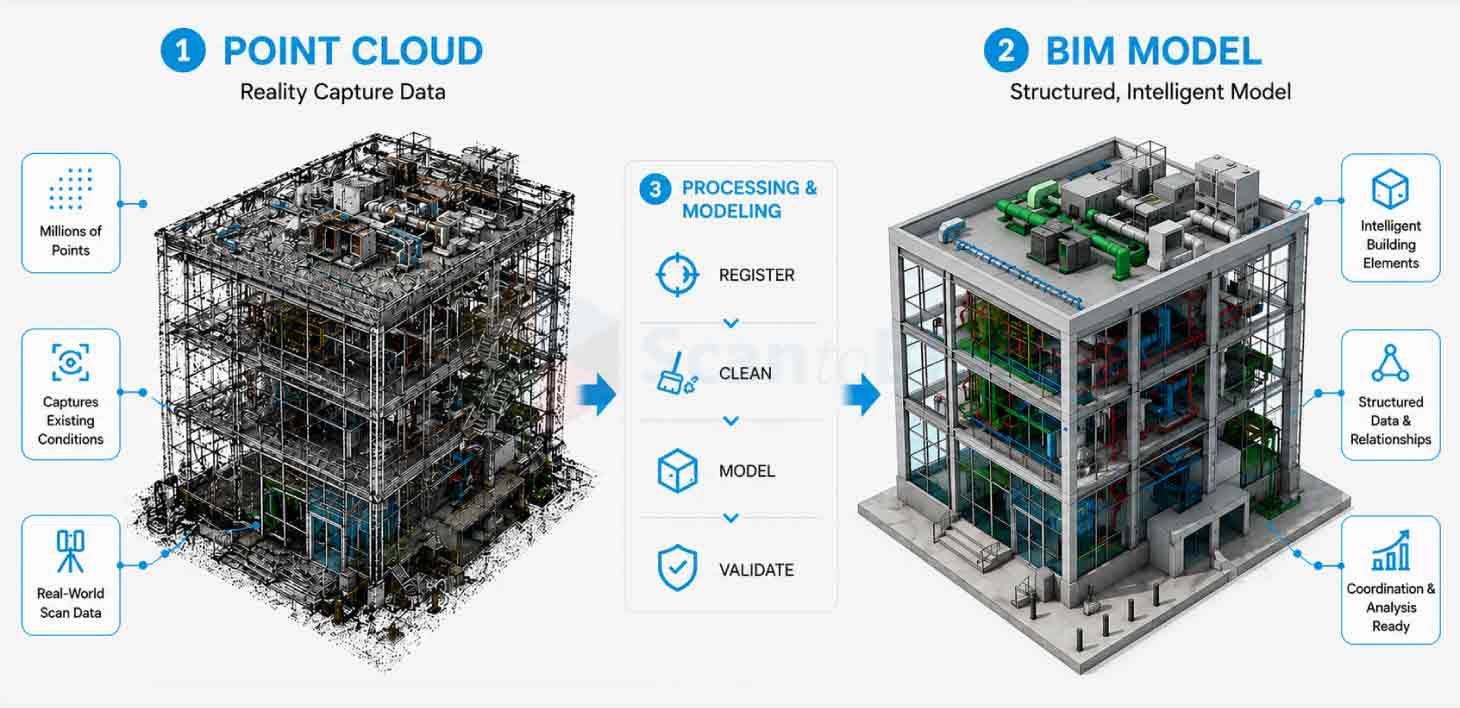
A laser scanner reads a space and turns it into a point cloud. That cloud holds millions of points, and each one marks a real surface. Specialists take this data and build a working digital model from it. The model holds walls and beams. It also holds ducts, columns, and the equipment that a team plans around. Each part carries its details, like material type and size. So the model becomes much more than a picture. Teams use it as the reference they return to during design and renovation.
The conversion step is where experience shows. A skilled modeler reads a messy point cloud and still places each part correctly. They work in Revit, and they follow the Level of Development the project asks for. Good Scan to BIM services join this modeling skill with real-world sense. That mix gives a team a model they can trust. It also saves the hours a crew would spend checking the site by hand.
Why Do Companies Outsource Scan to BIM?
Firms outsource for reasons that add up together. The in-house team rarely has free hours to convert a big point cloud before a deadline. Modeling software costs a lot to license. Trained modelers are hard to find and harder to keep. An outside partner already owns the tools and employs the people. So a firm gets expert work the day a project needs it, with no setup.
What draws firms in? Faster delivery sits near the top. Lower fixed cost matters too, and so does the chance to scale up when work grows. Outsourcing also passes the routine modeling to someone else, which frees your designers to design. A firm trades a high fixed cost for a cost it can plan around per project. For a growing studio, this trade creates opportunities for movement that slow hiring cannot match.
In-House Modeling vs Outsourcing: A Simple Comparison
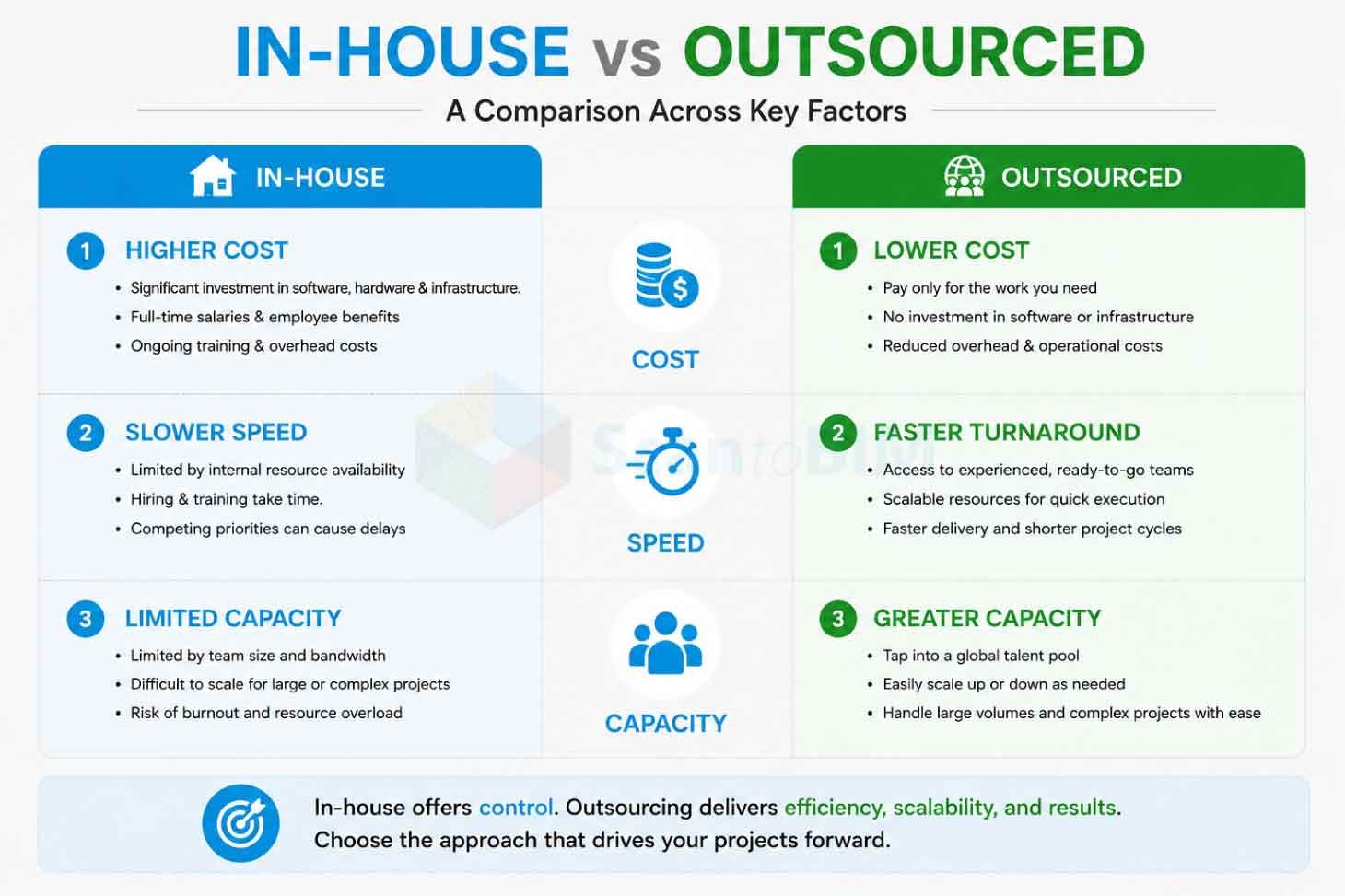
Many construction firms try to run scan conversion in-house first. It feels like control. The cost of that control, though, hides in places the budget sheet misses. You pay for the Revit seats. You pay for a computer strong enough to handle big point clouds. You pay a salary through the slow weeks when no scan data comes in. And you pay the most while a new hire learns on your live projects.
Outsourcing changes the math. The cost moves from fixed to flexible, so it rises and falls with your real workload. A partner already owns the licenses and the trained staff, so you skip the long start-up. You also gain the flexibility that an in-house team rarely gives. When three projects land in one week, the partner scales up. When work slows down, you owe nothing.
In-house still wins in one spot: quick, daily talks about tricky design intent. A modeler down the hall reads a sketch faster than one far away. So, the smart choice for many firms is to use both. Keep a small in-house team for the delicate work. Send the heavy, repeat conversion work out. That balance gives you control where it counts and savings where it does not hurt.
Pros of Outsourcing Scan to BIM Services
Outsourcing pays off across cost, speed, and the quality of the model itself. A good partner arrives with systems shaped by hundreds of jobs. Here is where the value shows up.
Cost saving:
A firm skips the software licenses, the new hardware, and the long search for new hires. Instead of paying modelers through slow months, the firm pays for finished work. One study in the Journal of Building Engineering looked at these factors directly. It found BIM raises coordination and cuts project changes by 6% to 47%, depending on the case. That range is wide, yet even the low end pays back the modeling cost.
Faster work:
A dedicated team works across shifts and returns models fast. That speed keeps a renovation schedule on track. An early model means the crew finds clashes early, and an early clash costs almost nothing to fix.
Depth of skill:
A seasoned Scan to BIM company puts people on your job who model tight MEP layouts every day. They know the current standards well. They notice the odd geometry a newer modeler would miss. Your project gets that judgment from the first file.
Cons of Outsourcing Scan to BIM Services
Outsourcing has its challenges, and ignoring them helps nobody. Each one has a fix, though, once you see it coming.
Communication gaps
Different time zones can stretch a reply from hours into a day. Teams close that gap with a regular call, a shared tracker, and clear written briefs. The more you write down at the start, the less you chase later.
Uneven quality
A weak vendor hands back a model that misses the LOD or holds sloppy geometry. You stop this by asking for a sample first and by checking work at each stage. Set the standard in plain words, and the modeling team has nothing to guess.
Data security
Your point clouds and drawings often hold client and site details you cannot risk leaking. A serious partner answers with encryption, a signed NDA, and access limited to the right people. You keep ownership of everything from start to finish.
Common Challenges in Scan to BIM Projects and How to Fix Them
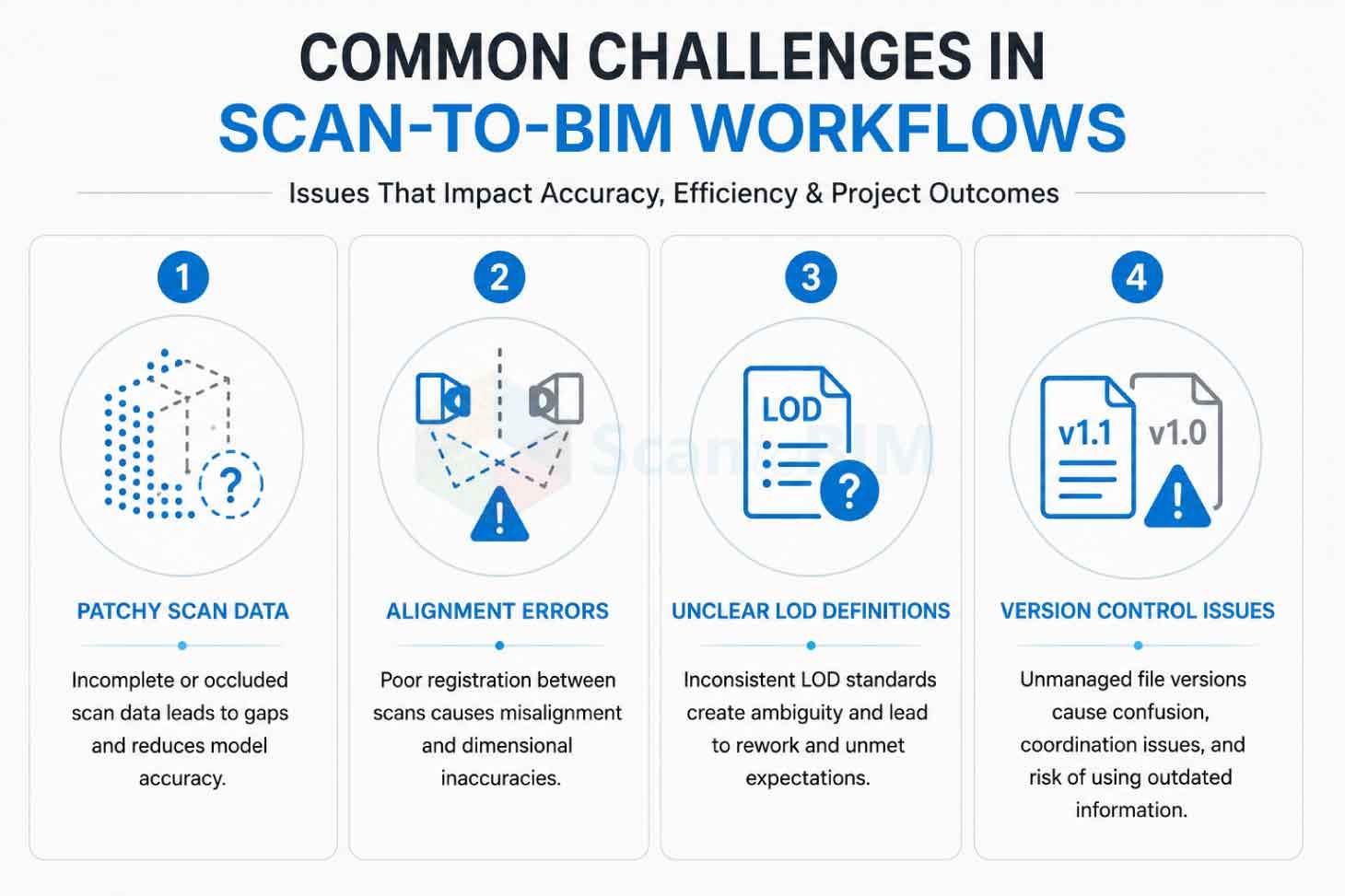
Even a smooth project hits problems. Knowing them early keeps small problems small.
Missing scan data
A scanner misses spots behind ducts, above ceilings, or inside tight plant rooms. The modeler then guesses, and guesses lead to errors. The fix sits with the field crew. Plan the scan to cover blind corners, and add stations where the layout gets busy.
Poor scan alignment
When separate scans line up badly, the whole point cloud bends out of shape. A model built on that base carries the same problem. So check alignment quality before any modeling starts, and reject a cloud that fails your limit.
Unclear LOD
A team asks for one level and expects another, and the gap shows up at delivery. Name the LOD for each part type up front. A door does not need the detail a chiller does, and saying so saves effort.
Version mix-ups
Two people edit, two files drift apart, and nobody knows which one is current. A shared platform with clear version control fixes this. One source, one truth, and the markups stay with it.
Key Factors to Consider Before Outsourcing
A few choices shape the whole project, so settle them early. LOD is the big one. The level you choose determines the cost, the effort, and the amount of detail you receive; specify it at the beginning. Pin down the software and version next, or models open badly on your side. Then set the scope tightly. List the disciplines, the floors, and the parts you want modeled. Loose scope creates rework, and rework eats the savings you came for.
Look closely at the partner's history with work like yours. A firm that lives in renovation and retrofit knows how odd an old building gets and how thin its drawings can be. Ask about their security policy, their review steps, and their terms for changes. Get pricing and timelines in writing before anyone starts. A solid Scan to BIM service provider calmly takes these questions and answers them with clear facts.
Best Practices for Outsourcing Scan to BIM
A clean setup carries the whole job. These habits keep things steady from start to handover.
Write a real scope document: List the deliverables, the file formats, the LOD, and the dates. Everything later leans on this one page.
Capture clean scan data: What you put in decides what you get back, so cover the whole space and align the scans well before you send them.
Keep a steady Scan to BIM workflow with checkpoints: Look at an early sample before the team goes into full production. A mistake caught now costs little, and a shared space for markups keeps versions clear.
Finish with a checklist: Walk through the geometry, the embedded data, and the LOD against your standards. Once it passes, the model is ready to build on.
How to Choose the Right Scan to BIM Outsourcing Partner
The right partner brings skill, and they also answer the phone and own their mistakes. Start with their portfolio, and look for jobs in your field, whether that is commercial, healthcare, or housing. Ask for a sample model and study it. Does the geometry hold up? Is the data set up the way you need? A confident firm shares references and takes on a small paid trial with ease. That trial tells you more about them than any sales pitch.
Check whether their team can grow with your pipeline. Make sure they handle point cloud to BIM outsourcing in the exact software you run. Watch how they answer your technical questions early on, because that habit holds through the whole job. Confirm the certifications, the NDA, and how they treat changes. A partner who meets deadlines and talks straight about tradeoffs is the one worth keeping.
How Does Outsourcing Affect Project Quality and ROI?
Outsourcing affects your model and your bottom line in measurable ways. Skilled modelers build coordinated models, and a coordinated model finds clashes while they are still cheap to fix. Catch a clash on screen, and you protect the budget, the schedule, and the client's patience. Early clash detection cuts the field rework that drives most cost overruns. So the modeling fee often returns far more than it costs.
The value carries past handover, too. A clean as-built model gives the owner a record they actually use for maintenance and the next renovation. Firms that route 3D laser scanning to BIM services through a strong partner tend to see better margins over time. The model keeps earning its cost across the life of the building.
Conclusion
Outsourcing Scan to BIM rewards firms that set it up with care. It lowers fixed costs, speeds the work, and gives you expert modelers without the weight of building a team. It does ask for something in return, mainly steady attention to communication, quality, and the safety of your data. Get those right, and you walk away with models you trust and returns you can show. So treat the choice of partner as a real decision, not a quick buy. Pick laser scan to BIM services from a team that meets your standards and keeps your dates. Do that, and outsourcing becomes a steady way to deliver accurate as-built work on every renovation you take on.