 +1 (409) 247-5496
 +61 468 036 171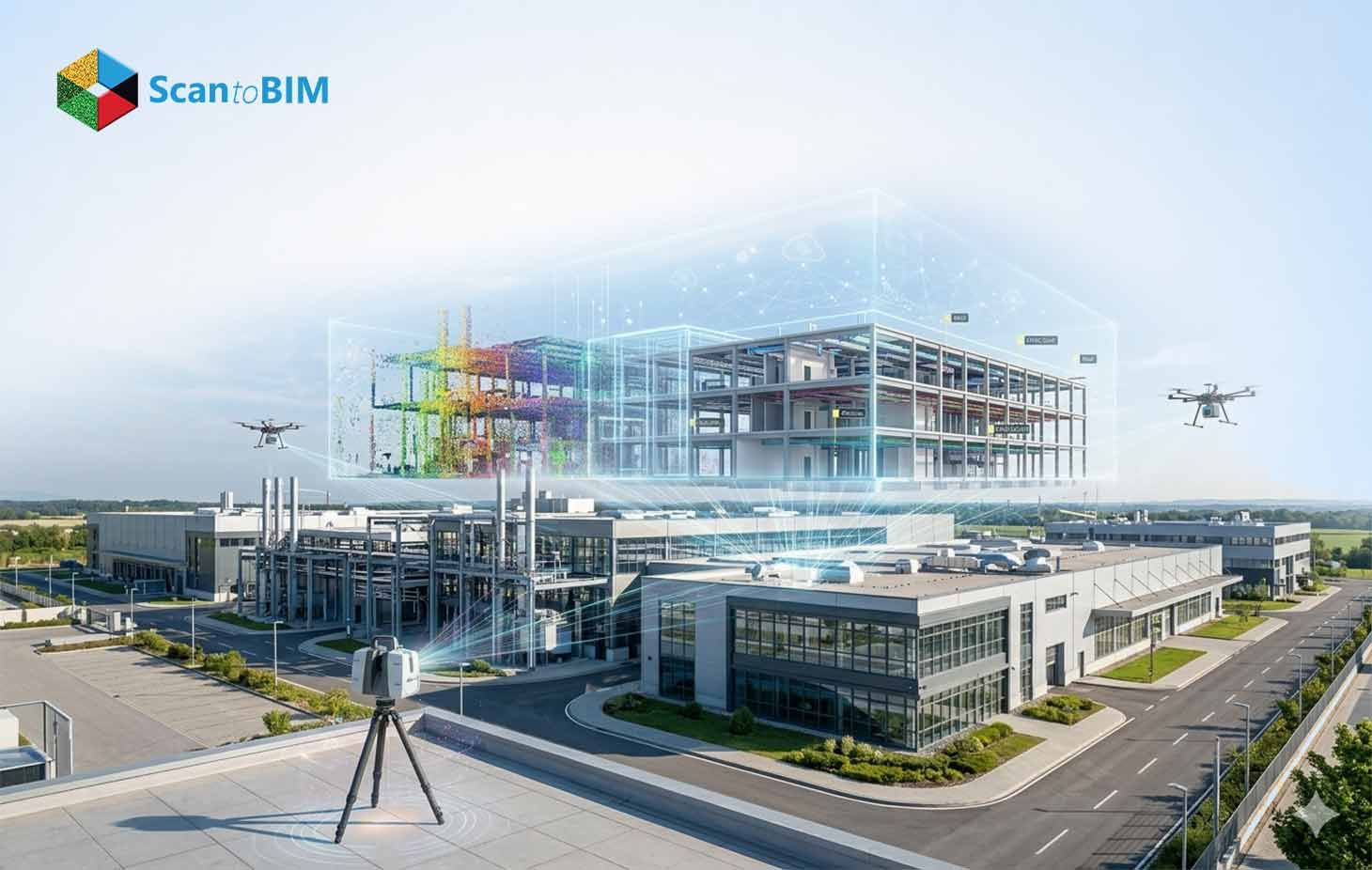
The AEC industry moves toward connected data faster every year. Teams capture buildings as point clouds, then convert that reality into intelligent models. Scan to BIM services sit at the center of this shift. They turn raw scan data into structured geometry that supports coordination, documentation, and lifecycle decisions.
Reality capture hardware now produces millions of points in minutes. Manual modeling once consumed weeks of that captured detail. Automation changes the pace. Software reads point clouds, recognizes building elements, and places parametric objects with growing independence. That change reshapes how design teams plan, staff, and price their projects.
This article walks through the trends pushing this field forward. Each section covers one force: artificial intelligence, advanced point cloud processing, cloud workflows, digital twins, and robotic capture. Together, they map where automated modeling heads next.
Understanding Scan to BIM Automation
Scan to BIM automation describes the use of software intelligence to convert captured reality into modeled geometry with limited manual input. A scanner records a space as a point cloud. The model then represents walls, floors, ducts, and equipment as highly detailed objects.
Scan to BIM automation compresses the slowest stage of this pipeline. Traditional modeling asks a technician to trace each surface inside the cloud. Automated routines detect those surfaces and propose objects directly. Teams review and refine instead of building from zero. Scale changes the math entirely.
Picture a hospital retrofit, heritage record, or campus survey. Each one buries a modeler under geometry. A technician tracing all of that by hand spends weeks on work that the software now reads in a sitting. Pair AI with BIM, drones, laser capture, and the decision cycle on a project shrinks from a monthly rhythm to a daily one. That speed lands hardest on the jobs that used to drain the most hours.
This is exactly where ScantoBIM.Online's AI-powered workflow proves its value. By automating surface detection and object placement, the platform has helped teams achieve 50% faster project delivery, turning timelines that once stretched across weeks into a matter of days. Its automated QC process adds another layer of confidence, catching deviations and validating geometry against the source cloud to deliver a 30% increase in accuracy. Speed and precision stop competing and start reinforcing each other.
The same logic guides Point Cloud to BIM Services. Survey data flows through a structured conversion and lands as a coordinated deliverable. Speed climbs, and the team still owns every quality call along the way.
Artificial Intelligence in Scan to BIM
Artificial intelligence does most of the work in automated modeling. The training process feels almost familiar once you see it. Feed a model thousands of scanned spaces. It starts to recognize a beam, read a pipe against a wall, and find a door in the noise. Show it a fresh point cloud afterward, and it sorts the parts on its own.
Element Recognition and Classification
A deep learning network breaks the cloud into regions that mean something. Each cluster picks up a label: this is structure, that is an opening, and this run is ductwork. Work that swallowed a modeler's afternoon now finishes in seconds. Speed is the headline. Consistency is where AI in Scan to BIM proves its value. The system labels the ten thousandth wall the way it labeled the first.
Automated Object Placement
Recognition is only half the job. After the model spots a wall, it drops a parametric object onto that surface. The object gains real substance too: thickness, a material tag, the logic for how it joins its neighbors. Automated BIM modeling hands the team geometry that already schedules and tags itself, so nobody rebuilds that data later.
Practitioners often frame this as scan to BIM automation through AI. The longer a model runs, the better it reads a site. Every finished project becomes training data for the next one.
Advanced Point Cloud Processing Technologies
Point cloud quality decides model quality. Cleaner input produces stronger output. New processing methods refine that input before any object placement begins.
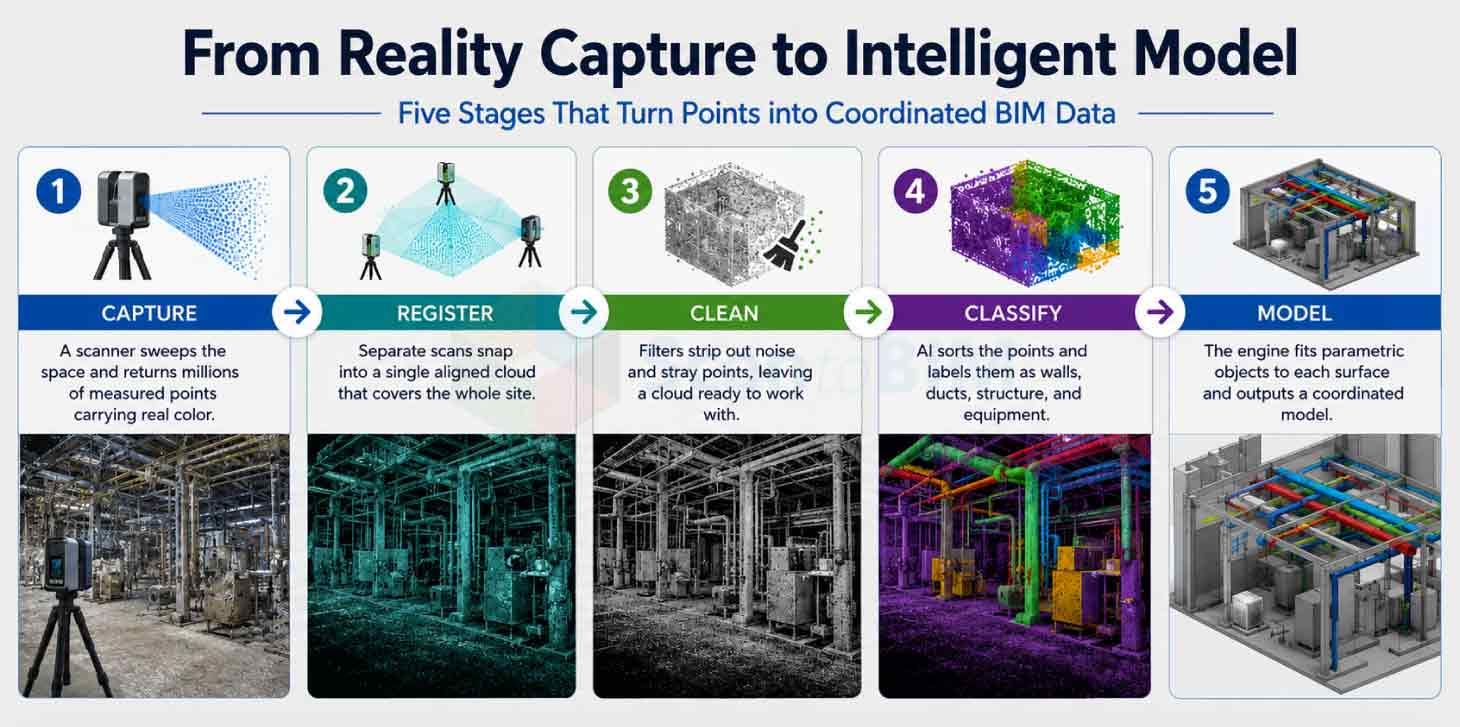
Point cloud processing automation handles registration, noise removal, and classification as connected steps. Registration aligns multiple scans into one unified cloud. Filtering strips out stray points from moving people or reflective surfaces. Classification then sorts the remaining points by likely element type. Each step prepares the data for faster, cleaner modeling.
Modern engines also handle 3D laser scanning output at massive densities. They compress the octree index and stream billions of points inside standard hardware. Technicians navigate huge sites smoothly because the software manages memory with care.
Stronger processing supports BIM from laser scanning at scales that manual methods struggle to match. A clean, classified cloud becomes the dependable foundation for automated geometry.
Cloud Powered Scan to BIM Workflows
Cloud platforms lift the heavy processing off the machine on your desk. A team uploads its point clouds to remote servers built for exactly this kind of load. Registration, classification, modeling: the platform churns through all of it at a pace that leaves a single workstation far behind.
Geography stops mattering as much. An engineer in one city opens the same coordinated model that a modeler worked on an hour ago on another continent. They look at one source of truth, replacing the old folder of conflicting copies. When somebody edits, the change reaches everyone at once. File transfers and version confusion mostly fade away. On-demand scaling is the other draw. A firm spins up extra computing power for a big job and lets it go once the work ships. Peak weeks stop forcing hardware purchases that nobody wants to pay for the rest of the year. That elasticity keeps several projects moving at once.
Security sits underneath all of it. Encryption protects the data in transit, and at rest, permissions decide who opens what, and audit trails record every step. Project information stays guarded from upload through final delivery.
Integration with Digital Twin Technology
A scan to BIM model freezes a building at one instant. A digital twin refuses to stay frozen. Digital twin technology integrates static geometry into live feeds around it. Think about sensor readings, the maintenance backlog, and the operating schedule. Automation makes the wiring practical. A fast, accurate conversion gives the twin a geometric base it can trust. That base carries asset IDs, material data, and the spatial relationships between everything. Facility teams stack their operational data on the frame. Physical reality and its digital record begin to move in sync.
Owners are the ones who benefit here. Inside the twin model, they watch how equipment behaves and schedule maintenance before a failure. They test a change there before anyone touches the real thing. Buildings drift over time. So a fresh scan every so often keeps the model aligned. The twin stays honest because the capture keeps feeding it.
That lifecycle reach is why Scan to BIM technology outgrew the design phase years ago. For the longer view, read how Scan to BIM reshapes the AEC industry.
Robotics and Autonomous Reality Capture
Scanners ride robots now. A legged platform picks its way through an active site while crews work around it. Overhead, a drone traces a facade no one wants to reach by lift. Both gather their data with little control over the process.
The payoff shows up fast. Send a machine into the tight, hazardous corners a person should avoid, and the risk drops to zero. Run it down the same route every Friday, and the progress data lines up week over week. That repeatability is exactly what a site team wants when it checks a build against a design. Capture turns a special event into a standing appointment.
Automated modeling closes the loop. A robot grabs the cloud, the platform processes it, and a refreshed model lands. Nobody touches the tracing. The team sets the new model beside the design and catches drift while it is still cheap to fix. This rhythm drives the broader scan to BIM trends toward steady, sensor-led documentation of a site as it grows.
Facing Future Scan to BIM Automation
Automation gets stronger every year. The human role remains strong alongside it. Software takes the grinding, repetitive detection and placement off the plate. A skilled modeler steps in where the cloud turns ambiguous. Somebody still reads intent, settles the judgment calls, and signs off on what ships.
Look at where the BIM automation trends are heading, and the loops keep tightening. Models will refresh from scans on a set cadence. AI will raise its hand when something shifts between two captures. The hours a team once burned on tracing now move toward decisions that actually need a person. The numbers already point this way.
Take one well-known example. A coordinated, model-led delivery at Sutter Medical Center cut field-generated change orders by 40%. Pull that coordination earlier with stronger automation, and the same advantage shows up sooner on every job. Standards provide a complete view. Open formats like IFC let an automated model travel between tools and carry its data along intact. Hold the classification steady, and that data stays useful long after handover, through the whole life of the building.
Conclusion
Automated scan to BIM matters because it connects physical reality to usable project data with speed and accuracy. Each trend in this article supports that goal. AI recognizes elements, processing cleans the input, cloud platforms scale the work, twins extend the model, and robots gather reality.
These forces work together rather than alone. A firm that combines them gains faster delivery, cleaner coordination, and models that serve the full building lifecycle. Expert teams stay central to that outcome. They guide the automation and certify the result. The path ahead favors firms that treat automation as a capability, and expert judgment as the standard that keeps it dependable.